
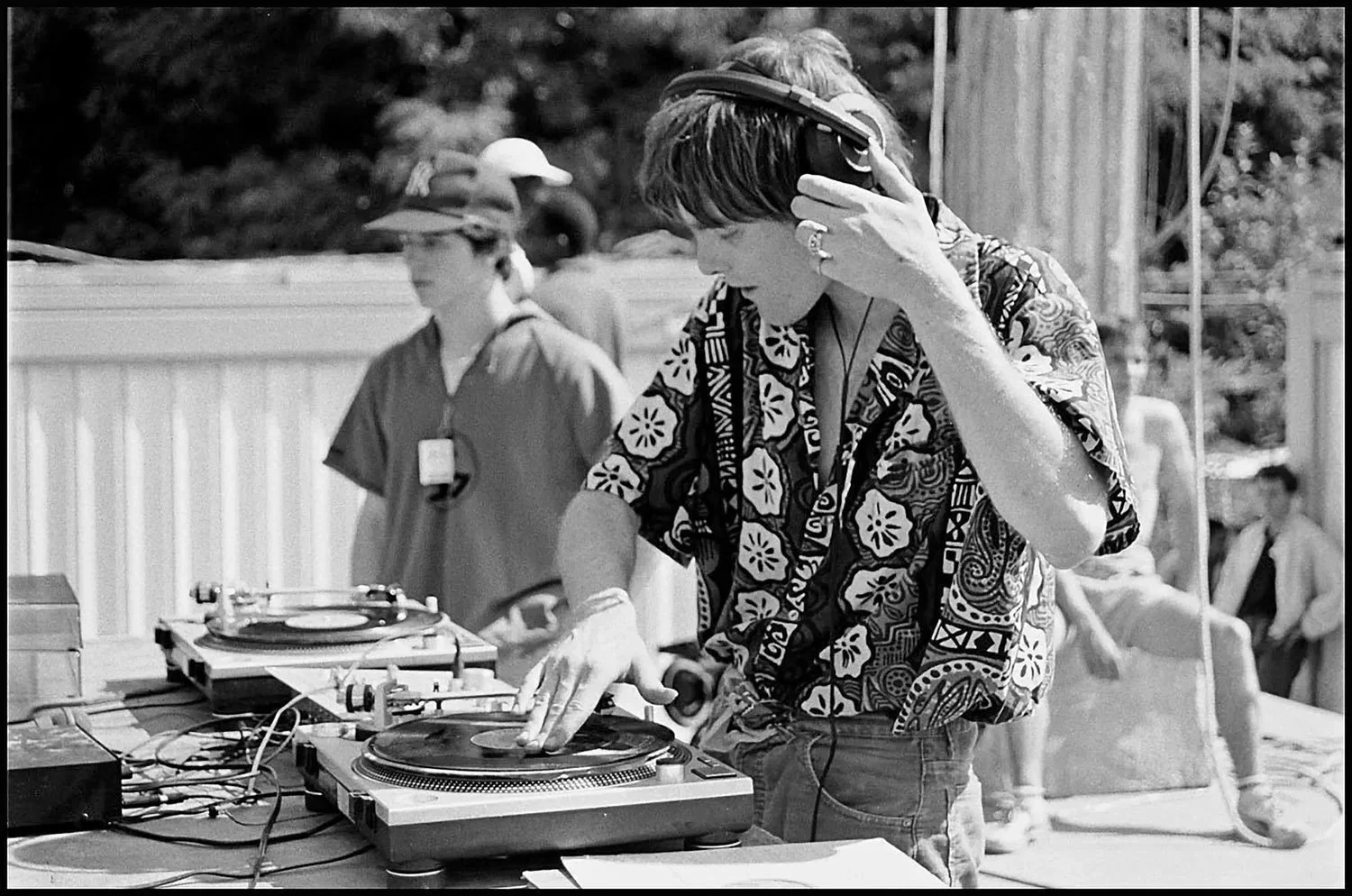
Dee Nasty - Aubervilliers, 1985
First edition, limited to 15 copies + 2 artist's proofs.
Details
- Titled, numbered, and hand-signed by the photographer
- Printed on Fine Art paper: Hannemülhe 308 g/m², 100% cotton
- Comes with a certificate of authenticity featuring a unique hologram guaranteeing the work’s authenticity and value
Price
Contact the gallery
Photographer
A native of the 9.3 district, Willy Vainqueur is one of the key witnesses to the emergence of hip-hop culture in France. After completing his university studies in audiovisual communication tools and techniques, he entered the field of documentary photography and became a photojournalist for local and national media outlets.
His work is thus deeply rooted in Seine-Saint-Denis. He collaborates with the cities of Aubervilliers, Saint-Denis, Pantin, La Courneuve, and Bobigny, documenting these communities and their residents in great detail.
As early as the 1980s, he began photographing the emergence of the hip-hop movement in Seine-Saint-Denis. In particular, he documented the early days of hip-hop through images of the first “Battle de Fêtes et Forts,” held in Aubervilliers in 1985. In doing so, he has built a significant photographic collection dedicated to urban and musical cultures.
Throughout his career, Willy has collaborated with the music press and covered major music festivals. His photographs have been published in leading publications, including *Libération*, *Le Nouvel Observateur*, *Le Matin de Paris*, *L’Express*, *Actuel*, *L’Humanité*, *Best*, *Jazz Magazine*, *West Africa *, and *Black Magazine*.
Willy’s photographs are now featured in major exhibitions dedicated to the history of hip-hop in France and its overseas territories:
Red Bull, Point Fort, Aubervilliers 2026
Jardins Créoles, Mois Kréyol Festival, Martinique and French Guiana 2022
Hip Hop 360, Philharmonie de Paris 2021
Paris London, Palais de la Porte Dorée, Paris 2019
Hip Hop, a Golden Age, MAC, Marseille Museum of Contemporary Art 2017
30 Years of Hip Hop, Saint-Denis City Hall 2013
Willy is now working to document urban transformations and the ephemeral work of graffiti artists, which has become increasingly enduring with the recognition of street art.
Willy Vainqueur Talks About His Photo
-
Dee Nasty behind the turntables in 1985—that’s rare. How did this photo come about?
It’s 1985. I’m covering the “Fêtes et Forts” festival at Fort d’Aubervilliers in the 93. It was the major event that launched hip-hop in France… alongside Sydney’s H.I.P.H.O.P. show, of course!The event is organized by Claude Kiavué, nicknamed Jimmy, a cultural activist and leading figure in Guadeloupean culture. He went around handing out flyers in all the housing projects in July 1984. It was the middle of July. And yet, a lot of people showed up—after all, not many people go on vacation in the housing projects! He announced that we were going to organize a big event.
Back then, they weren't called "battles" yet, but rather "intercity challenges."
It brought together more than twenty crews from the suburbs, who competed against each other in dance and, above all, graffiti.
Tell us about the music he’s mixing at the exact moment you’re photographing him.
At that time, Dee Nasty was, in my opinion, in the midst of promoting the album he’d released a year earlier with Lionel D: *Panam City Rappin’*. It was still a sort of mix of rocksteady, funk, and even electro-funk, with lyrics in French—not necessarily very politically engaged, unlike the American rap of the time.But, in fact, the hip-hop sound is already here. It’s still in its infancy, but very much present. This sound would quickly take off with the launch of the parties at Globo and the monumental impact of his show *Dee Nasty* on Nova. It was a bustling time.
The audience is dancing and joining in with the dancers on stage. There’s a roar of excitement every time the dancers perform a new move. Behind them, people are spellbound, because we’re truly witnessing the beginning of something.
What impresses you the most at that moment?
Dee Nasty is in his element. He’s killing it. You can tell he’s focused and fully present.It was a beautiful day, you know, when the music was there, alive, and above all, there was a celebration of this emerging culture. It was completely unique at the time.
Beyond the innovative artistic aspect, what interested me was the social movement it sparked, given the political context of the time, when things were still very, very tough for young people in the suburbs.
What does Dee Nasty mean to you?
He’s undoubtedly a pioneer, because he was one of the first to go to the United States to bring this music and culture back to France and help them evolve here. He’s truly a giant in this culture.He was in contact with Afrika Bambaataa in the United States. He was therefore at the heart of this emerging culture, which had already gained a strong foothold across the Atlantic.
There were also graffiti artists who had gone to the United States: Solo, Squat, Bando, Kool Shen, JonOne, Colt, Sign… So there was a small network of people who brought this music and culture to France. But Dee Nasty is truly one of the pioneers in the field of DJing.
For Dee Nasty, the starting point was the Chapelle field, because it was his place, his space—the one he had made his own. You had to climb over a wall to get to the other side. He’d play his music, and people would come to listen while tagging the walls of the field.
He was actually really laid-back. He didn't have the B-boy look yet, unlike the dancers he was performing with.
40 years later, why is this image so iconic?
It’s iconic for two reasons. First, because it’s Dee Nasty, the godfather of hip-hop and DJing in France. He was the one who played a major role in launching the movement musically. It’s mind-blowing when you think about it. On the other hand, because this scene takes place at one of the founding venues of hip-hop in France: the Fort d’Aubervilliers, in the 93.There, he’s scratching. It was pretty rare because, aside from the shows in Sydney, it was one of the first times we’d seen and heard scratching. And it was pretty impressive, the way he created a sound right there on the spot.
Scratching is insane—being able to take two records and recreate a song, to produce something new: that’s iconic, too. And Dee Nasty is one of the pioneers of these techniques.
And he’s influenced every generation that followed. We’re really at the very, very beginning of a story. Dee Nasty is a legend in urban culture.
This is obviously an archival photo. It takes on its full meaning precisely because it isn’t a digital image. Back then, we worked in black and white, using 36-exposure film. So we were careful about what we chose to photograph. And seeing this printed image today is a great joy, because what remains in the history of photography are also these images created using silver-based processes, which stand the test of time and have now become true works of art.