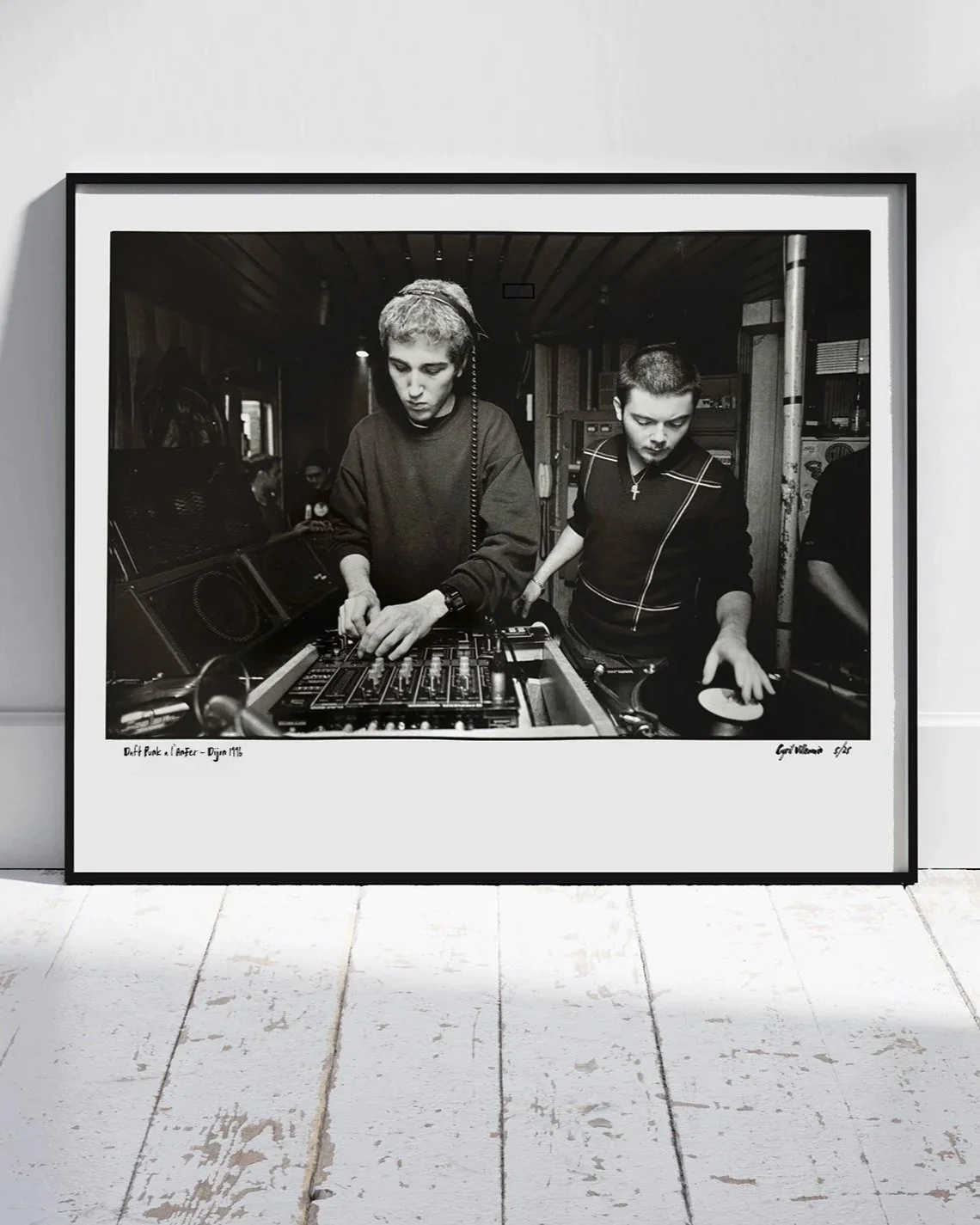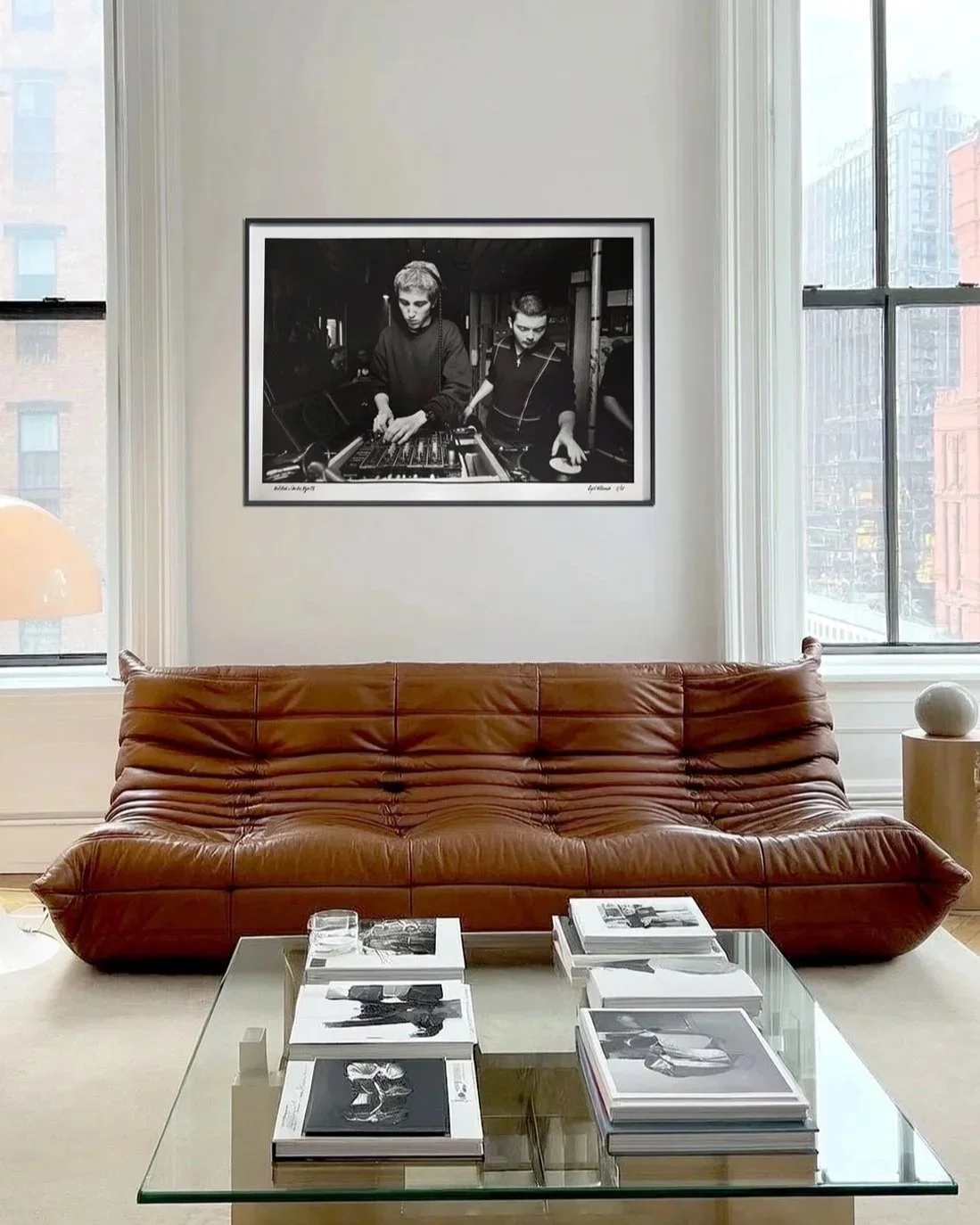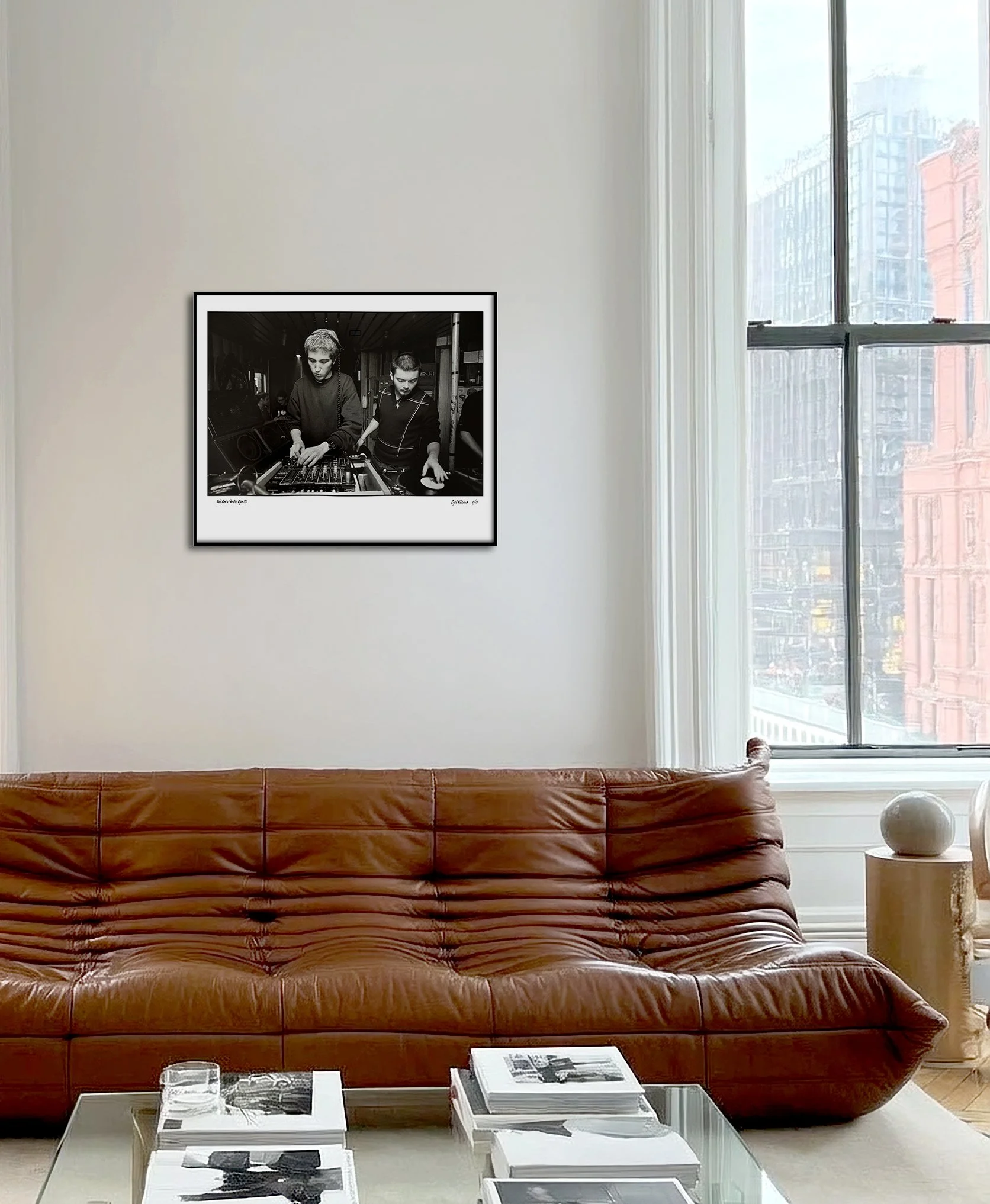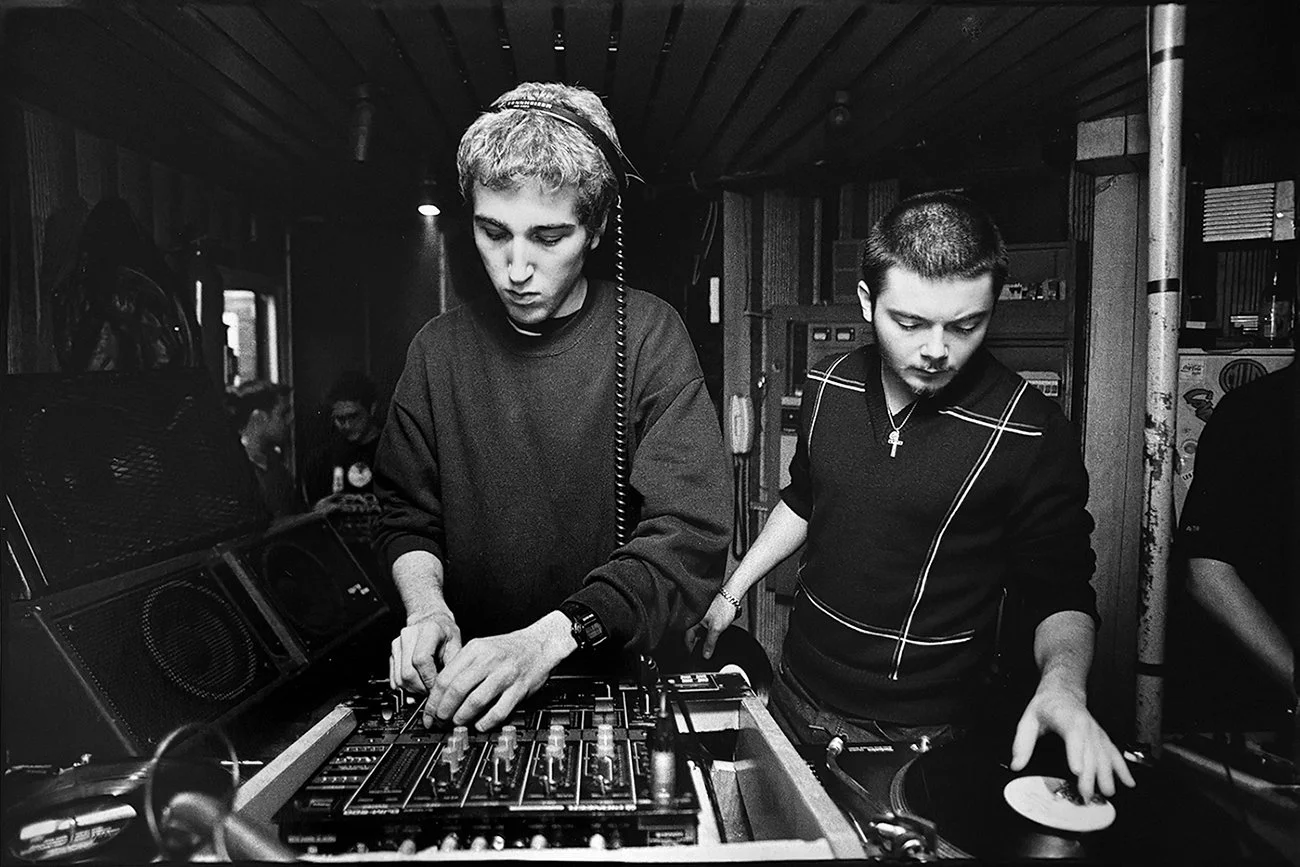
Daft Punk - DJ set at L’An-Fer, Dijon, 1996
First edition, limited to 25 copies + 2 artist's proofs.
Details
- Titled, numbered, and hand-signed by the photographer
- Silver gelatin print on Ilford Baryta Multigrade FB Warmtone paper
- Comes with a certificate of authenticity featuring a unique hologram guaranteeing the originality and authenticity of the work
Sizes:
- 50 × 60 cm, 60 × 90 cm, 90 × 120 cm
Price:
upon request
Photographer
A native of Burgundy, Cyril Villemain began his career as a photojournalist in 1995. His passion for electronic music and parties naturally led him to cover the legendary techno nights held at the Dijon club L’An-Fer. For a year, he documented the rise of those who would become the leading figures of the techno scene: Laurent Garnier, Daft Punk, Dimitri from Paris, Manu le Malin, Jack de Marseille, Carl Cox, Jeff Mills, Basement Jaxx, DJ Pierre…
Cyril then turned his attention to national and international news, covering conflicts in Lebanon, Israel, and Palestine, as well as in the Balkans. Over the course of his 22-year career, he worked for various media outlets, including AFP, CORBIS/Sygma, SIPA Press, The Guardian, Libération, 20 Minutes, and The Economist. He ended his career as a photojournalist in 2017 with a report on the presidential elections in Kenya. His photo of a Masai Samburu warrior leaving a polling station made the front page of the German daily Suddeutsche Zeitung.
A tireless adventurer, Cyril now lives in Africa and is developing the rum brand he founded: Bahari Rum.
Behind the Lens
-
1. Hi Cyril, how did you end up taking photos at An-Fer that November evening in ’96?
I was 23. I was working for the newspaper Le Bien Public, where I had set up, with a young journalist friend, a column about what was happening on Friday nights at An-Fer in terms of techno. An-Fer was “the place to be” for DJs back then. Everyone had played there. It was a massive scene since Laurent Garnier had been a resident DJ there. It was a super famous spot.2. What’s the vibe like in the club when Daft Punk take the decks? What’s their set like?
The party was called ‘This is Coda’. I remember it was very late and I was starting to get a little tipsy when Daft Punk started mixing. Their first EP had come out on Soma; it wasn’t yet the global smash hit that Homework would become. They weren’t super famous yet.The Daft started DJing late—really, really late. They had to play some killer tracks, because it was 3 a.m., so you can’t play anything slow; you need something that really gets the party going! They dropped funk, soul, disco, and house tracks. And at one point, they really got the crowd going: they played “Rollin’ and Scratchin’” to see how it would go over. And it went over like a house on fire! Everyone was dancing. “Rollin’ & Scratchin’” set the An-Fer on fire.
I think they figured: we’ll play “Rollin’ and Scratchin’” when everyone’s really getting into it; we’ll put it on at 3 a.m. You can’t play that track at midnight because at that hour it’s too slow—people aren’t into it yet. It’s a club where people don’t start showing up until 1 a.m. So, in my opinion, they’re thinking: “We’ll play it right when the crowd is ready to take the track.”
3. What’s your mindset when you take these photos?
It was pretty quick. It must have lasted about two songs—I’d say 3 or 4 minutes. I took very few photos because we only had a tiny two-column article with a single photo.I had a Nikon F4 with a cobra flash and a 24mm lens. It was the only lens I could use at An-Fer—it was that dark. I set up a flash on the ceiling, with a plastic box attached to the end of the flash to prevent overexposure, because the booth was pitch black.
I knew my settings by heart: aperture at f/2.8, I was using Ilford HP5+ 400 ISO pushed to 800, and I used a bit of indirect flash with the diffuser on the cobra head. I was shooting at 1/60th of a second, and not a single photo is blurry—it’s funny. The Dafts probably didn’t move much; they must have been pretty static. There’s even detail in the background: you can see the DJ booth, which was painted black, without any light—it’s pretty mind-blowing.
I had loaded a 24-exposure roll of film and used up half of it. The first photo was taken when it shouldn’t have been; I must have pulled the film out before it had even started. So now we have a “zero” photo that should never have existed.
Guy-Man came up from behind with his record—maybe because he saw that photos were being taken? In photo 1, he puts on a record, then switches it out in photo 9. In fact, you can see him putting on a white label. Then there’s a photo where he’s all alone. Then Thomas is alone again. In photo 9, Guy-Man comes back… um… I don’t have a super clear memory of that. I’m in a bit of a fog; I think I’d had a few drinks. But the goal was to try to get it perfect right away, you know. And it holds up—they’re straight!
4. Tell us about that memorable conversation you had with Pedro Winter, the Daft Punk manager, backstage.
When I was done, I went back to the DJ booth to meet with the editor and another journalist. Then this guy I didn’t know at all walked up to me and said, “Hey, I see you took some photos—what’s that for?”- I tell him, “I work for the regional daily newspaper. It’s for an article on Daft Punk, those two guys.”
- He replies, “Listen, I’m their new manager. You can’t publish the photos, because in a few days, we won’t be seeing their faces anymore. So I’d like the photos not to be published.” ”
Then everyone looked at each other, thinking: a manager for DJs? That’s a bit weird, isn’t it? There were guys who booked DJs, but no one who managed them.I was a bit condescending when I said, “Listen, man, I’m a freelancer, so if I don’t get the photos published, I don’t get paid.” We had a drink. The photo appeared in the newspaper two or three days later, and it was the last photo ever published of Daft Punk without their helmets.
5. In your opinion, what makes this image so magical?
I talked about it again with the editor who covered the story. He remembers that when they played “Rollin’ & Scratchin’,” it totally set An-Fer on fire. And when you see what “Rollin’ & Scratchin’” did the following year on the charts: it was A HUGE HIT. And Thomas and Guy-Manuel…no one knew what they looked like. That’s why this photo has become pretty iconic.Another editor who was there—and who is now the editor-in-chief of a radio station—showed the photo to his staff, who are Gen Zers. The guys looked at it and said, “No way, you were standing right next to Daft Punk without a helmet!” It felt to him like he was talking about a photo of the Beatles on Abbey Road. It was iconic to them, because Daft Punk is huge, after all.
There’s also a journalist standing in the back in Photo 1; he must be checking out one of the records the Daft were playing, just to get a look at the tracks they were spinning. There are other guys in the back, and they’re also tapping on the flight case to see what records they’re playing. You know, the guys hanging out in the DJ booth. Six months later, it had become impossible—that was over! There’s almost a “small-town” to this photo.
They look totally ordinary; no one could have imagined back then that Daft Punk would go on to become a global sensation. You just couldn’t tell. And when you see what they’ve become… it’s just mind-blowing. This is the last time we see Daft Punk in public without their helmets. As the locals say, “In Dijon, there was Bob Marley…and Daft Punk.”